| RDF (Radio
Direction finding) Lightning sensor
The DF sensor is an original concept and design by
Frank Kooiman and thanks to the help of
Daniel Verschueren.
This system was developed as a hobby alternative to the existing
commercial Boltek lightning detector. The advantages of the
lightning radar are the low cost (€40 and up) compared to the
Boltek (€350 to €600 depending on the
version),
the extreme sensitivity of the system, and the possibility of
joining the group system via the internet. Where Boltek
detectors can detect lightning up to a range of 500km, the LR
(lightning radar) has a range of 2000 to 3000km over land and
several thousand km over water (e.g. lightning in Florida, south
America).
One disadvantage of the LR is that it is not a plug-and-play
system and therefore requires some knowledge of electronics and
familiarity with a soldering iron. In practice, this is not
really a disadvantage since it means that
you learn a lot more about the science of detecting lightning.
The software functions as a single station showing the direction
and estimated distance, or connects with other LR stations via
the internet to perform a localisation function, displaying the
result (specific direction and distance) on a map. In addition
these maps can be uploaded to your website.
The electronics consists of
an amplifier which boosts and filters the signal from an antenna
and passes it to the soundcard of a computer (Line-in).
The lightning strikes are received using a frame antenna set at
10 kHz. At this frequency range the lightning sends impulses
over a range of several thousand kilometres. The antenna
consists of a frame, around which wire is wound in multiple
windings. The antenna measures the magnetic part of a wave and
has the advantage that it is less sensitive to interfering
electrical fields. With a single antenna, the lightning strike
can be detected but the direction cannot be measured. For this
reason a second identical antenna is mounted at 90 degrees to
the first antenna.
The direction can be calculated from the two
signals measured. It is still not possible to say for certain
that the lightning strike occurred at one direction, exactly
opposite direction could also have been possible (+180 degrees).
This is also due to the fact that we do not know if the
lightning strike had a positive or negative charge. If you are
working with a single station, a third antenna is therefore
necessary to detect the charge and therefore the correct
direction of the strike. A single station cannot be used to
determine the
exact position / distance of the strike. This can
only be estimated from the strength of the signal, since not all
lightning strikes have the same energy. Lightning Radar works in
a group of a number of stations and can therefore calculate the
correct direction and the position / distance using only 2
antennas. Now
I have in test two ferrite antennas just like the ones used for
the TOA system. It's not simple to adapt them to the RDF hardware
but some good result is coming :-)
You can find information about
Lightning Radar on:
http://www.lightningradar.net
http://lr37.dyndns.org/fr/indexfr.html
|
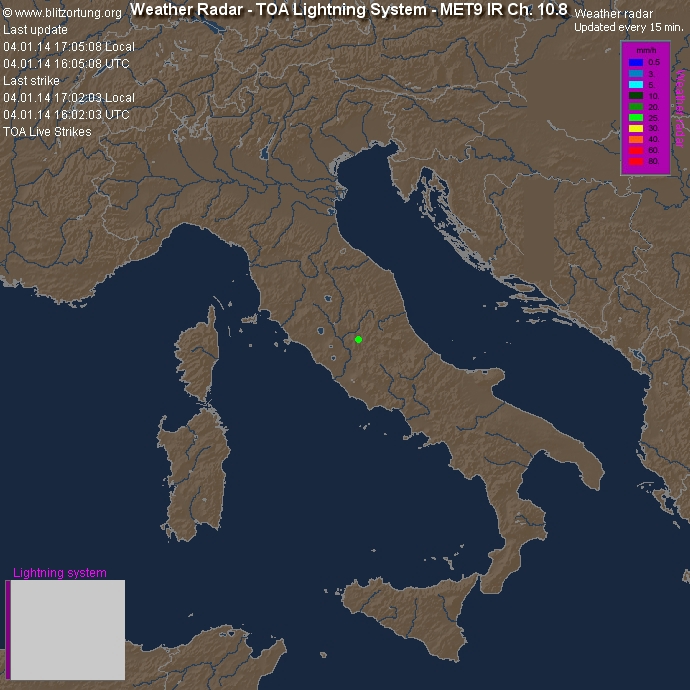
TOA (Time of Arrival)
Lightning sensor
The TOA sensor is developed
thanks to the Egon Wanke
Blitzortung.org project.
The
lightning location network Blitzortung.org consists of several
lightning receiver sites and one central processing server. The
sites transmit their data in short time intervals over the
Internet to the server. Every data sentence contains the precise
time of arrival of the received lightning strike impulse (”sferic”)
and the exact geographic position of the site.
With this information from all sites the exact positions of the
discharges are
computed.
The complete sensor with ferrite antennas is
included in a plastic enclosure. The antennas are connected to
the VLF pre-amplifier thanks to an RG316 cable. The amplifier is
necessary to amplify the lightning signal to be avaluated from
the microprocessor. An easy way to realize a VLF pre-amplifier
is to use an operational amplifier (op-amp).
After the signal is amplified, it's passed to the evaluation
board that make the
computations
and associates the signal with a time stamp.
The heart of the evaluation board is an Atmel 8-bit AVR micro
controller ATmega644 running with a clock frequency of 20 MHz.
The board also contains two 10-bit analogto-digital converters
AD7813 that operate in high speed mode not powered down between
conversions. In this mode of operation the converters are
capable to provide a throughput of 400 kSPS.
The pre-amplifier and the evaluation board can be connected by a
1-to-1 shielded cat cable via the RJ45 jacks. This makes it
possible to use the same power supply for both boards.
The GPS receiver we need has to provide a one-pulse-per-second
(1PPS)
output with an accuracy of at least ±1μs, and a serial interface
using either RS232 or TTL level. The communication between the
GPS receiver and the evaluation board is done with 4800 Baud, 1
stop bit, and no parity. The evaluation board only reads the
GPRMC sentence from the GPS output.
The TOA (time of arrival)
lightning location technique is based on hyperbolic curve
calculations.
The emitted radio signals of a lightning discharge are
travelling with the speed of light. These are approximately
300000 kilometres per second. Each received signal is
time-stamped at the receiving sites. The time-stamp differences
are used for hyperbolic curve generation. The point of
intersection of all hyperbolic curves defines the location of
the source of the radio signal. The computed position is then be
assumed to be the location of the lightning stroke. At least 4
sites are needed to define always a unique intersection of the
hyperbolic curves. With more than four receiving sites reporting
the same signal there is some redundant information available to
improve the accuracy and to verify the performance.
 |